
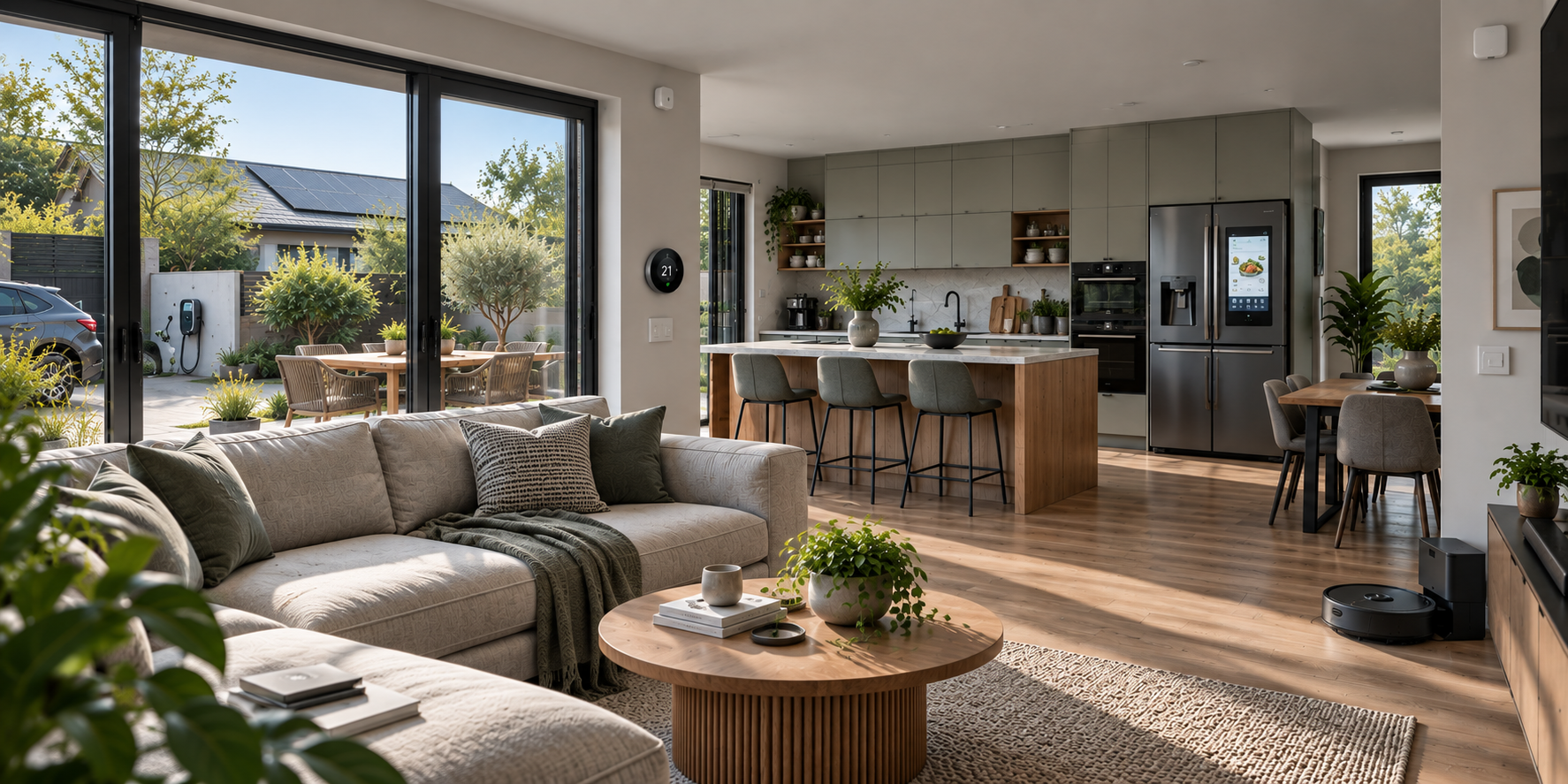
We've made our homes smart. What comes next?
For years, the idea of a smart home has largely been about giving us new ways to control things.
Instead of walking over to the thermostat, we can adjust the heating from an app.
Instead of pressing a light switch, we can ask a voice assistant.
Blinds can close on a schedule. A video doorbell can tell us someone's outside. A robot vacuum can start cleaning while we're at work.
All of that can be useful.
But in most cases, we're still making the decisions.
We tell the device what to do, or we create a rule telling it what to do later.
The next stage of the connected home could be quite different.
At CES 2026, AI-driven personalisation and predictive automation were prominent smart-home themes, with systems increasingly being designed to anticipate needs through adaptive lighting, security, appliances and thermostats that learn routines.
Instead of simply waiting for instructions, the home begins using information from sensors, connected devices and AI to understand what's happening around it.
That's where the smart home starts becoming the intelligent home.
Smart, automated or intelligent?
These terms can easily become mixed together, particularly when almost every new product seems to have smart or AI somewhere in its name.
But there is a useful distinction.
A smart home responds to you.
You open an app and turn the heating down.
An automated home follows rules you've already created.
Every weekday at 9am, the heating drops to a temperature you've chosen.
An intelligent home begins to use context.
It understands that nobody is currently home and adjusts the heating because the rooms aren't being used.
The difference might seem small, but it changes the relationship we have with the technology.
Instead of programming every action individually, we're gradually asking the home to understand more of the situation for itself.
That doesn't mean every product currently described as AI-powered can genuinely understand your home. There's still a large gap between an impressive demonstration and a home that can reliably make useful decisions every day.
But the direction is becoming clearer.
Your home could start understanding whether a room is actually being used
A traditional motion sensor has a fairly simple job:
Movement or no movement.
But a home can potentially combine much more information.
Is somebody present?
How bright is the room already?
What's the temperature?
Has a window been opened?
Which rooms are occupied?
What time is it?
Instead of each sensor triggering an isolated action, those signals can begin providing context.
Imagine sitting in your living room on a bright afternoon.
A basic automated home might turn the lamps on at 4pm because that's the schedule you created.
A more intelligent system could recognise that you're in the room but there's already plenty of natural daylight — so the lights remain off.
The technology hasn't necessarily done anything dramatic.
In fact, it has done less.
But it has made a better decision.
The home starts learning your routines
Most households have patterns, even when nobody has deliberately programmed them.
You might usually get up around the same time during the week.
The kitchen is occupied in the morning.
The living room becomes the main space in the evening.
Bedrooms are empty for much of the day.
Heating requirements change depending on which parts of the home are actually being used.
An intelligent home could increasingly learn some of these patterns instead of requiring you to create dozens of schedules and automations yourself.
The important word, though, is assist.
Learning a routine shouldn't mean the home suddenly gets to decide how you live.
People come home early. Plans change. Guests visit. Someone decides to work from home unexpectedly.
A system that's genuinely helpful needs to recognise that routines aren't rules — and make it easy for you to override its decisions.
Our devices need to stop behaving like separate islands
There's a strange problem with today's smart home.
The more smart products you buy, the more complicated your home can become.
You might have one app for your heating.
Another for your lighting.
Another for your cameras.
Another for your robot vacuum.
Another for an appliance.
Suddenly the technology that's supposed to simplify the home has given you a folder full of apps.
That's why interoperability matters.
Standards such as Matter are designed to make it easier for compatible devices and ecosystems to work together. The Connectivity Standards Alliance's Matter 1.6 update in 2026 continued that work, including improvements intended to support better coordination and more context-aware control across ecosystems.
The interesting future isn't necessarily a house containing hundreds of smart gadgets.
It's a smaller number of useful systems that can understand one another.
Because once the home becomes connected as a whole, intelligence becomes much more useful.
AI could become another layer on top
This is where things start getting particularly interesting.
Today, we often control smart homes one action at a time.
Turn the heating down.
Switch the downstairs lights off.
Start the robot vacuum.
Close the blinds.
But AI systems could increasingly allow us to express an intention rather than issue every individual instruction.
Imagine telling your home:
“We're away until Monday.”
A sufficiently capable system could potentially use that information to coordinate the connected systems you've permitted it to control.
Heating requirements change.
Lighting routines could change.
Cleaning could happen while nobody is home.
Energy consumption could be adjusted.
Security systems could behave differently.
We're not yet at a point where every ordinary home can reliably operate this way, and giving software greater control over the physical home raises important questions of its own.
But it represents a fundamental change.
Instead of controlling devices, we could increasingly be giving the home an objective.
Energy might be where home intelligence becomes genuinely useful
Turning lights on automatically is convenient.
Managing an increasingly complicated household energy system could be much more valuable.
Imagine a home with solar panels, a battery, an electric vehicle, smart heating, connected appliances and an electricity tariff where prices change throughout the day.
Suddenly there are lots of decisions to make.
When should the battery charge?
When should the EV charge?
When should stored electricity be used?
When is the cheapest time to run an energy-intensive appliance?
Should heating behaviour change depending on occupancy?
Home energy optimisation is already an important part of the smart-home industry, alongside smart thermostats and utility-connected technologies.
As those systems become more sophisticated, the homeowner may increasingly set the priorities while software works out the details.
Perhaps you care most about reducing your electricity bill.
Perhaps you want to maximise how much of your own solar energy you use.
Perhaps you want the car charged by a particular time.
The intelligent home could increasingly work around those goals rather than requiring you to micromanage every device.
Even the kitchen is starting to understand what's inside it
The refrigerator is a surprisingly good example of how household appliances are changing.
Samsung's 2026 Bespoke AI Refrigerator Family Hub expanded its AI Vision system using Google Gemini. Cameras and AI can recognise a wider range of food being added to or removed from the fridge, while connected software can assist with food management, grocery planning and recipe suggestions.
It's still an emerging technology, with limitations around recognition, supported products and availability.
But think about what the idea represents.
Traditionally, a refrigerator knows one thing particularly well:
how cold it is.
Increasingly, manufacturers want it to understand:
what's actually inside it.
And once appliances understand more about their surroundings, they can potentially provide more useful assistance.
We'll explore this properly in another Space Lab article, because the idea of a kitchen that understands its contents raises plenty of questions of its own.
But what happens when the intelligent home gets it wrong?
This is the less exciting part of the future home — but probably one of the most important.
Technology fails.
Internet connections disappear.
Sensors misread situations.
Software has bugs.
Routines change.
And AI systems can misunderstand what people want.
If your music recommendation is wrong, you skip the song.
If your home incorrectly decides nobody is in the room and turns something off, that's considerably more annoying.
As we give software control over more physical parts of our homes, how the system behaves when it's wrong becomes just as important as how clever it is when it's right.
A good intelligent home shouldn't trap you inside its intelligence.
The physical light switch should still work.
You should still be able to control the heating.
Automations should be understandable and easy to disable.
And essential household functions shouldn't become unnecessarily useless because an internet service isn't available.
The smartest feature in the home might sometimes be a simple manual override.
Intelligence also requires information
There's another trade-off.
For a home to understand what's happening inside it, the home needs information.
That could come from relatively simple sensors measuring temperature, humidity or light.
But it could also include presence sensors, microphones, cameras, connected appliances and information about household routines.
Those aren't all equivalent from a privacy perspective.
A temperature sensor knowing that a room is 21°C is very different from an indoor camera interpreting what's happening inside that room.
So as homes become more intelligent, there are questions worth asking before enabling every feature available:
What information is being collected?
Does it stay inside the home or get sent to the cloud?
How long is it stored?
Who can access it?
Can individual features be switched off?
Will the device still work if you don't want to share certain information?
Some emerging systems are specifically exploring more local processing. For example, a CES 2026 Innovation Award honoree demonstrated contextual home automation using on-device computer vision rather than requiring cloud connectivity.
That doesn't remove every privacy consideration, but it demonstrates that intelligence doesn't necessarily have to mean sending everything elsewhere.
The smartest home might be the one you notice least
For decades, our image of the “home of the future” has often involved screens everywhere.
Touch panels.
Flashing controls.
Futuristic interfaces covering walls and appliances.
But perhaps we've imagined it backwards.
If your home genuinely understands enough context, you may actually need to interact with technology less.
You don't open an app because the room is already comfortable.
You don't turn on a light because the home knows there's enough daylight.
You don't spend ten minutes changing settings before leaving for a weekend because the systems understand that the house will be empty.
You don't think about when the battery charges because your energy system has already worked out an appropriate time.
And when you do want something different, you simply change it.
Perhaps the goal isn't:
More technology in the home.
Perhaps it's:
Technology that requires less of our attention.
So, how intelligent should your home be?
There probably won't be a morning when we wake up and suddenly realise we live in an intelligent home.
The change is more likely to happen gradually.
A thermostat becomes better at understanding occupancy.
Lighting becomes more responsive to natural light.
Appliances learn more about how they're being used.
Energy systems start making more decisions automatically.
Different devices become better at working together.
And AI becomes another layer connecting those systems.
For some people, the ideal home might eventually anticipate almost everything.
Others may prefer a thermostat, a few smart lights and a robot vacuum — and nothing more.
Neither home needs to be considered more advanced simply because it contains more technology.
The real measure should be whether that technology makes the home work better for the people living in it.
We've spent years asking what our homes can become capable of doing.
As they become capable of doing more for themselves, perhaps the more interesting question is:
How much intelligence do we actually want to give them?