Homes are being asked to do a lot more than they used to.
A living room might also be somewhere to work, exercise and entertain. A spare bedroom might spend most of the year as an office before turning back into a guest room when someone stays over. Someone running a business from home might need space to work, create, store products or meet clients — without wanting their home to permanently feel like a workplace.
Even the garage, kitchen and garden can now have additional jobs, from home gyms and workshops to growing food and managing solar power and batteries.
For a long time, homes have largely been designed around rooms with fixed purposes. But if the way we use our homes is becoming more flexible, perhaps the spaces themselves need to become more flexible too.
Our homes are doing more than housing us
Think about everything that can now happen under one roof.
We work and run businesses from home. We exercise there. We study and learn online. We create music, videos, art and other content. We entertain ourselves with gaming and home cinema setups. Some households grow food, charge electric vehicles or generate and store their own electricity.
Our homes can also need to change as our lives change. A nursery becomes a child's bedroom. A bedroom becomes an office. An office might eventually need to accommodate an older relative. A dining area that rarely gets used for formal meals could become somewhere to study or run a small business during the week.
A modern home might also be used as a:
-Workplace or business — from remote working and consulting to storing stock and packing online orders.
-Gym or wellness space — for exercise equipment, yoga, stretching or meditation.
-Creative studio — for art, crafts, photography, music, making or content creation.
-Learning space — for studying, online courses, tutoring or home education.
-Entertainment space — for gaming, films, music or hosting friends.
-Guest space — accommodating visitors without keeping a bedroom empty for most of the year.
-Workshop or hobby space — using garages, spare rooms or other areas for practical projects.
-Growing space — from windowsill herbs and indoor growing systems to balconies and productive gardens.
-Energy hub — generating solar power, charging an EV or housing batteries and other home-energy equipment.
-Care space — adapting as children grow, relatives move in or different generations share the same home.
Not every home needs to do all of these things. The point is that the boundary between “home” and many of the places we once travelled to is becoming less clear.
That puts new pressure on the space we already have.
The answer can't always be to add another room. Sometimes the more interesting question is: could the room we already have do more?
Flexible doesn't have to mean complicated
The idea of a transformable home can bring to mind futuristic apartments where walls move at the touch of a button and furniture disappears into the ceiling.
Those ideas exist, and we'll come back to them.
But flexible living can be much simpler.
It could mean being able to close your workspace when you've finished for the day. It could mean a guest bed that doesn't occupy an entire room when nobody is staying. Or a living and dining space that can be divided when you need privacy and opened again when you want more room.
There are plenty of ways a room can become more adaptable:
-Sliding or movable walls can divide one large room into smaller spaces when privacy is needed.
-Pocket or folding doors can separate areas without permanently closing them off.
-Fold-down desks can turn an empty wall or cupboard into a workspace.
-Murphy or fold-away beds can allow a bedroom to become an office, gym or studio during the day.
-Modular furniture can be moved, separated or rearranged depending on how the room is being used.
-Expandable tables can stay compact day-to-day and provide more surface space when needed.
-Hidden or built-in storage can conceal work equipment, exercise gear or business supplies when they're not being used.
-Movable shelving and screens can create temporary zones without constructing permanent walls.
-Furniture on wheels can make changing a layout quicker and easier.
-Adaptable lighting can support focused work during the day and help the same room feel more relaxed in the evening.
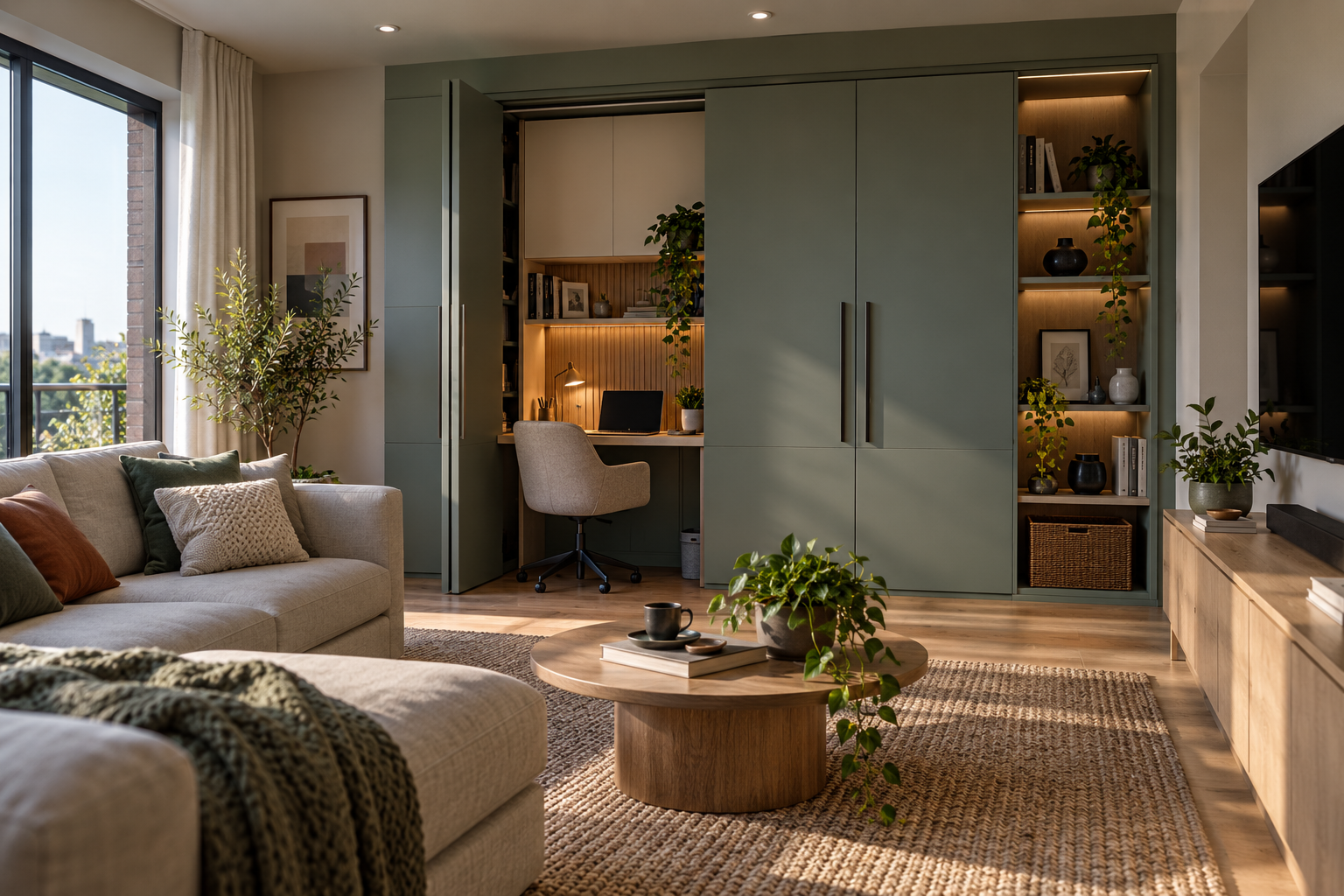
-Multifunctional cabinetry can conceal a desk, television, hobby station or other equipment behind doors.
-Motorised or movable furniture systems can physically transform a room, offering a glimpse of where flexible living could go next.
Good flexible design isn't about constantly rearranging your home.
It's about giving a space more than one useful configuration without making the change difficult. The best solution is the one that makes changing the room quick and easy enough that you'll actually do it.
Hide functions when you don't need them
One of the simplest ways to make a room work harder is to stop everything needing to be permanently visible.
A desk can fold into a wall or disappear behind cabinet doors. A television can be concealed within furniture. Craft supplies can live inside purpose-built storage. A workstation can occupy part of a wardrobe rather than requiring a dedicated office.
This is particularly useful when work and home life share the same room.
If your desk sits in the corner of your living room, you're still looking at your workplace when you're trying to relax in the evening. Being able to close a door, fold the desk away or conceal the equipment allows the room to change character when the working day ends.
The same principle works for hobbies, exercise equipment and home businesses.
Sometimes flexibility isn't about moving the room around. It's simply about deciding what gets to remain visible.
Use furniture that earns its floor space
Furniture already takes up a significant amount of room, so asking it to perform more than one function can make a big difference.
A dining table can double as a generous workspace. An ottoman can provide seating and storage. A console can expand into a dining table. Modular seating can be separated and rearranged depending on how the room is being used.
Beds offer some of the biggest opportunities because of the amount of floor space they occupy.
Murphy beds and other fold-away systems can allow a room to function as an office, studio or exercise space during the day before becoming a bedroom at night. Some systems combine a bed with shelving, a sofa or even a desk.
The useful question isn't necessarily “How many functions does this piece of furniture have?”
It's “Will I actually use those functions?”
A complicated piece of transforming furniture isn't particularly clever if changing it is such a nuisance that you leave it in one position permanently.
Let rooms become bigger — or smaller
Walls don't always have to be completely permanent.
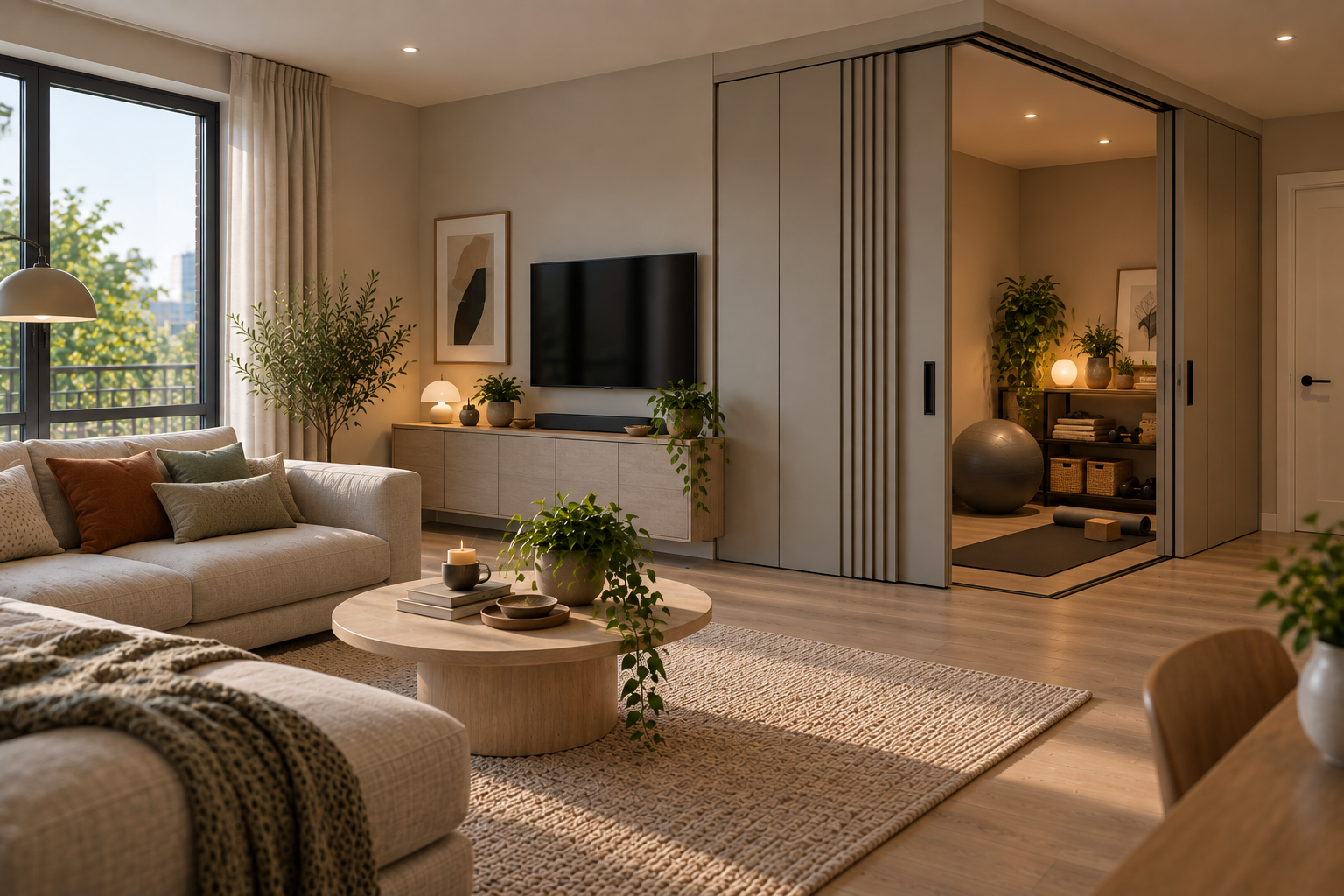
Sliding doors, pocket doors, curtains, screens and movable partitions can allow one larger area to become two smaller spaces when needed.
A home office could be separated from a living area during a video call and opened again afterwards. A kitchen might connect fully with the dining and living area when entertaining but become more enclosed at other times.
This also offers a middle ground between traditional separate rooms and completely open-plan living.
Open-plan homes can feel spacious and social, but they don't always work brilliantly when several things are happening at once. One person might be cooking while another is working and someone else is watching television.
Flexible divisions allow a home to be open when openness is useful and divided when privacy matters more.
Think in zones, not just rooms
A space doesn't necessarily need physical walls to have more than one purpose.
Lighting, rugs, furniture placement, shelving and changes in material can create different zones within the same room.
A corner with a desk, task lighting and shelving can feel like a workspace without becoming a separate office. A reading chair and floor lamp can establish a quiet area within a larger living room. An open shelving unit can provide storage while also creating a visual boundary between two activities.
Lighting can be particularly useful.
Bright task lighting might support working during the day, while warmer and softer lighting helps the same room feel completely different in the evening.
This kind of flexibility is less dramatic than moving walls, but for many homes it may be considerably more practical.
Give home businesses somewhere to go
Working from home and running a business from home aren't always the same thing.
A laptop might be enough for some jobs, but a home business can bring equipment, products, packaging, paperwork or clients into the property.
Someone selling products online might need somewhere to store stock and pack orders. A photographer or content creator might need a small studio. A tutor may need a quiet teaching area. Other businesses may need workspace that can be separated from the private parts of the home.
Without planning, the business can slowly spread.
Boxes move into the hallway. Equipment takes over the dining table. The spare bedroom becomes permanent storage.
Flexible design can help create boundaries. Built-in storage, adaptable workspaces, garden rooms, converted garages or spaces that close away at the end of the day can allow a business to exist within a home without necessarily taking over the home.
What businesses can operate from a residential property will depend on local rules, the property, insurance and the type of activity involved. But as home-based work continues to evolve, it's another reason the traditional idea of what each room is “for” is becoming less straightforward.
Make storage part of the transformation
Flexible rooms only work if everything has somewhere to go.
It's difficult to turn an office into a guest bedroom if monitors, cables and paperwork have nowhere to disappear. It's equally difficult to turn a living room into an exercise space if clearing the floor means moving everything into another room.
That's why storage isn't separate from flexible design — it's part of it.
Full-height cupboards, storage integrated into seating, wall-mounted systems, under-bed storage and built-in cabinetry can help a room move between different uses without simply moving the clutter somewhere else.
The easier it is to reset the room, the more likely you are to actually use it in different ways.
What happens when the room starts moving itself?
This is where flexible living gets more experimental.
Designers have explored apartments with movable walls that physically alter the floor plan. Motorised furniture systems can raise beds towards the ceiling, move storage units or reveal workspaces when they're needed.
Rather than having a bedroom, office and living room permanently occupying separate areas, the same floor space can effectively perform different jobs at different times.
That doesn't mean we're all about to install robotic furniture.
Cost, maintenance, reliability and the need for specialist installation mean many of these systems remain far removed from a simple fold-away desk or sliding partition.
But the idea behind them is interesting.
If a room is empty for most of the day, does it need to permanently occupy that amount of space?
A home that changes as your life changes
There's another kind of flexibility that happens much more slowly.
Our homes might need to serve us for decades, but our requirements during those decades can be completely different.
A room used for remote working today might become a nursery in the future. Children's bedrooms might later become hobby rooms, guest spaces or offices. A household may need to accommodate several generations. Mobility requirements can change as people get older.
Homes designed with adaptability in mind can potentially make those transitions easier.
That could mean accessible layouts, fewer unnecessary structural barriers, services positioned so rooms can change use, modular storage or simply avoiding designs that only work for one very specific lifestyle.
The flexible home isn't only about changing between morning and evening.
It can also be about changing between one stage of life and the next.
The future home might not need more rooms
It's easy to think that gaining another function means gaining another room.
Want to work from home? You need an office.
Want to exercise? You need a home gym.
Have guests? You need a guest bedroom.
Start a business? You need a studio or workspace.
For some households, dedicated rooms will absolutely make sense. But homes can't keep expanding every time our lifestyles change — and for many people, more space simply isn't an option.
Flexible living offers another possibility.
Instead of asking every room to have one permanent purpose, we can design spaces that adapt to what we need from them at different times.
Sometimes that might involve clever furniture or movable partitions. Sometimes it's simply better storage and thoughtful zoning. And eventually, we may see more homes where parts of the layout can physically reconfigure around the people living there.
The future of the home might not just be smarter technology or bigger spaces.
It might be a home that gets better at changing with us.