
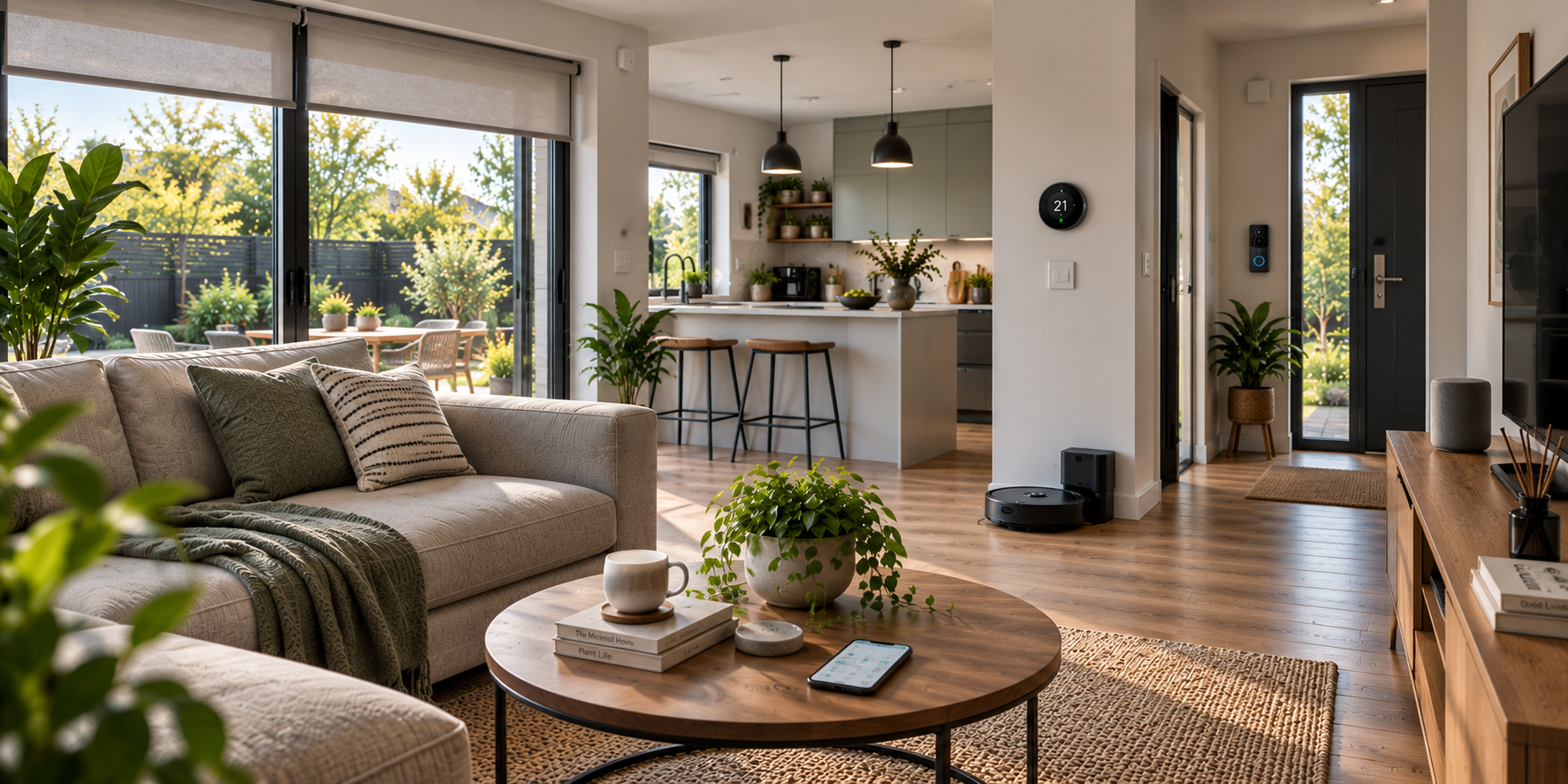
A smarter home doesn't have to be a complicated home
When people hear smart home, it's easy to picture a house filled with screens, voice assistants and expensive technology. But Smart Living doesn't have to mean replacing everything you own with something connected to Wi-Fi.
Sometimes it's as simple as having the heating turn off when you don't need it, a light that comes on when you're carrying something through the hallway, or a doorbell that lets you see who's outside when you're away from home. It might be a robot vacuum taking care of one repetitive job, or simply being able to check whether you remembered to switch something off after you've already left the house.
The technology matters, but what matters more is whether it actually makes living in your home easier. That's what Smart Living at Spacelo is about.
What do we mean by Smart Living?
Smart Living is about using technology and thoughtful products to make everyday life at home simpler, more comfortable, more efficient or more secure. That might mean connecting different parts of the home, but it can also mean choosing one device that solves one annoying problem particularly well.
You don't need a fully automated house. You don't need every light bulb to be smart, and you certainly don't need to replace something that already works perfectly well just because a connected version exists. Instead, we'll look at where smart technology genuinely adds something useful.
Start with the problem, not the product
There's an enormous amount of smart-home technology available, and the temptation can be to buy a device first and then work out what to do with it. We'd rather approach it the other way around.
What's frustrating about your home?
Maybe you're constantly adjusting the heating, or perhaps a dark hallway means you're always reaching for a light switch. You might want to know when a parcel arrives, reduce unnecessary electricity use, have the floors cleaned more regularly without spending more time doing it, or simply automate a few repetitive tasks.
Once you know what you're trying to improve, it becomes much easier to decide whether technology is actually the right solution.
Smart lighting
Lighting is one of the easiest places to start experimenting with a smarter home. Smart bulbs, switches, plugs and sensors can allow lighting to respond to schedules, movement or other conditions rather than relying entirely on someone remembering to switch it on and off.
But even here, there isn't one solution for every home. A smart bulb might make sense for a lamp, while a smart switch may be better when several lights are controlled together. A motion or presence sensor could be useful somewhere you regularly walk through with your hands full — and sometimes the ordinary switch on the wall is still the best option.
We'll explore those differences rather than assuming smart automatically means better.
Heating, comfort and energy
This is an area where connected technology can potentially do more than provide another gadget to play with. Smart thermostats and heating controls can make it easier to manage when and where your home is heated, while smart plugs and energy monitors can help you understand how certain devices are being used.
Solar panels, home batteries and EV charging are adding another layer to household energy management, and increasingly these technologies can work together. Smart Living will look at both the comfort and cost side of home energy, including where automation can help and where the potential savings may not justify buying additional technology.
Security without turning your home into a fortress
Smart doorbells, cameras, locks, sensors and alarms have made connected home security much more accessible. You can potentially see who's at the door when you're not home, receive an alert when a sensor is triggered or check whether something has been left open.
But more technology doesn't automatically mean more security. There are also questions around privacy, subscriptions, internet connectivity, battery life, data storage and what happens if a service stops working. We'll look at those trade-offs too, because a security product needs to do more than have impressive features — it needs to be dependable when you actually need it.
Taking some of the repetitive jobs out of the home
Not every smart device needs to solve a major problem. Sometimes saving a little time repeatedly is enough.
Robot vacuums are probably the clearest example, but they're far from the only one. Connected appliances, automated blinds, smart irrigation, pet feeders and other devices can take over small household tasks or make them easier to manage.
Some are genuinely useful, some solve problems most people never had, and some become much more interesting once they're combined with other devices. We'll try to work out which is which.
A connected home should work together
One of the biggest frustrations with smart-home technology is that products haven't always played nicely with one another. You can easily end up with multiple apps, accounts and ecosystems controlling different parts of the same house.
That's gradually changing. Standards such as Matter are designed to make it easier for compatible smart-home products to work across different ecosystems, although compatibility problems haven't disappeared completely.
When we look at products and systems, we'll therefore consider not only what they do, but also what they work with. That's particularly important if you're gradually building a smart home rather than buying everything at once.
You don't have to make the whole house smart
Smart Living isn't an all-or-nothing project. You might decide you want smart heating but couldn't care less about connected lighting. Someone else might want cameras and a video doorbell but have no interest in voice assistants, while another household might simply want two smart plugs and a robot vacuum.
That's still a smart home if those products make the home work better for the people living there. In fact, starting small can make a lot of sense: solve one problem, see whether the technology genuinely improves something, then decide whether it's worth going further.
And sometimes the smartest choice is keeping things simple
We'll be looking at plenty of new technology in Smart Living, but we're not going to assume every ordinary household product needs an app, subscription or AI feature.
If a £10 solution does the job better than a £150 connected one, that's worth knowing. If a smart product requires three apps and an account just to perform something a normal switch does instantly, that's worth knowing too.
And if something genuinely saves time, improves comfort, reduces waste or solves a problem that was difficult to address before, that's when smart technology becomes interesting.
What we'll explore in Smart Living
Over time, we'll look at smart lighting and automation, from individual bulbs to whole-room routines; heating and energy, including smart thermostats, energy monitoring, solar, batteries and EV charging; and home security, from cameras and doorbells to locks and sensors.
We'll also explore cleaning and appliances, smart kitchens, outdoor technology and smart-home ecosystems, along with individual products when there's something genuinely interesting about them. Some solutions will be inexpensive additions, while others might involve a much larger investment.
The aim isn't to build a home containing as much technology as possible. It's to find the technology that's actually worth having.
Build the smart home that works for you
There probably isn't such a thing as the perfect smart home. Every household has different routines, budgets, properties and ideas about how much technology they actually want around them.
So Smart Living isn't about telling you that your home needs to become smarter. It's about exploring what's possible, understanding the choices and helping you decide where technology could genuinely make your home better — and where you might be better off without it.
Welcome to Smart Living.