You don't need to make everything smart
Building a smart home can quickly sound like a much bigger project than it needs to be. There are connected versions of lights, locks, doorbells, thermostats, cameras, plugs, appliances and almost everything in between.
But a smarter home doesn't have to start with replacing everything you already own. In many cases, one or two carefully chosen devices can make a bigger difference than filling every room with technology.
The best place to start is to ask what you'd actually like your home to do differently. Maybe you want to control the heating more easily, automate some lighting, keep an eye on the house while you're away or simply spend less time vacuuming.
Once you know the problem you're trying to solve, choosing the technology becomes much easier.
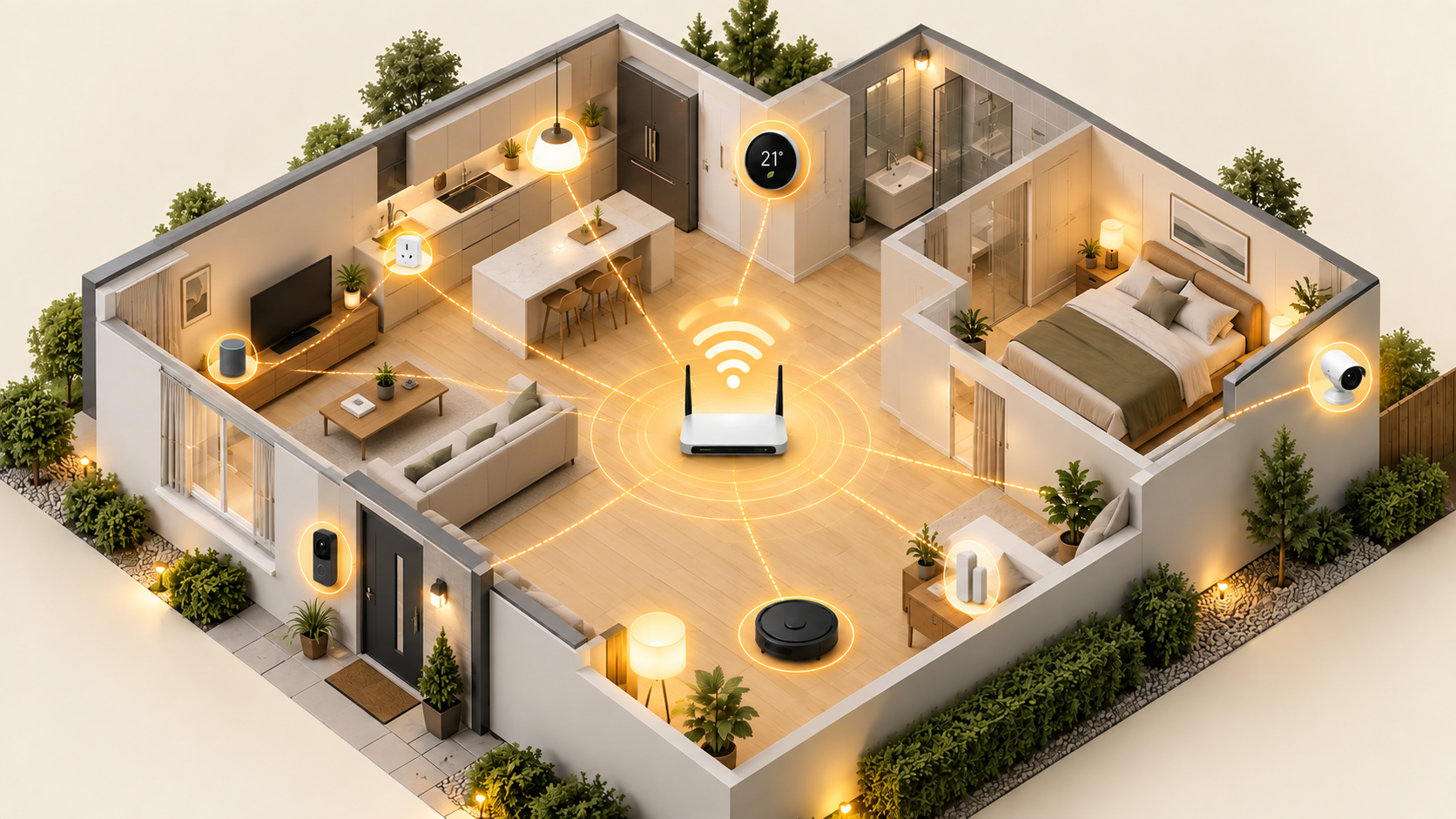
Start with something you already have: Wi-Fi
Before buying smart devices, it's worth thinking about what will connect them.
A reliable home network is an important part of many smart-home setups. Cameras, speakers, plugs and other connected products can become frustrating if they're installed somewhere with a weak or unreliable signal.
Walk around your home and consider where your Wi-Fi struggles. A router hidden in a cupboard or positioned at one end of the property may leave other areas with poor coverage. Depending on the home, repositioning the router or using a suitable mesh Wi-Fi system can help improve coverage.
Not every smart-home device communicates directly over Wi-Fi. You may also encounter technologies such as Thread, Zigbee and Bluetooth, sometimes communicating through a hub or other controller. The important thing isn't to become an expert in every protocol before buying anything — it's to check what a product needs and whether it will work with the setup you already have.
1. Smart lighting
Smart lighting is one of the easiest ways to experiment with home automation because you can start with a single lamp or room.
Depending on the system, you can control lights remotely, dim them, change their colour or temperature, put them on schedules and combine them with sensors or other devices. A hallway light could respond to movement, for example, while living-room lighting could change automatically in the evening.
Before buying, think about how the light is normally controlled. Smart bulbs can work brilliantly in some situations, but smart switches may make more sense elsewhere — particularly if people are likely to keep turning the normal wall switch off and disconnecting the smart bulb.
2. Smart plugs
If you want to make an existing device a little smarter without replacing it, a smart plug can be a useful place to start.
They can allow compatible appliances to be switched remotely or put onto schedules, and some models can also monitor electricity consumption. That makes them particularly interesting if you've used our Energy Saver and want to investigate the actual consumption of a suitable plug-in device.
But a smart plug doesn't magically make every appliance smart. Some devices won't resume operating simply because power is restored, while others shouldn't be remotely switched for safety or practical reasons. Think about what you're connecting rather than treating a smart plug as suitable for everything.
3. Smart speakers and displays
Smart speakers can do much more than play music. Depending on the ecosystem and connected products you choose, they can provide voice control for lighting, heating, plugs and other devices around the home.
A smart display adds a screen, which can be useful for things such as viewing a compatible video doorbell, controlling devices or displaying information.
You don't necessarily need one in every room. Starting with the area where voice control would actually be useful can help you decide whether you want to expand later.
4. Smart hubs and controllers
As your smart home grows, you'll probably want different products to work together rather than opening a separate app for everything.
That's where hubs, controllers and smart-home platforms become more important. Depending on the products you choose, these can help devices communicate, run automations and provide one place to manage more of the home.
Compatibility matters here. Before committing heavily to one ecosystem, look at what it supports and whether the products you're considering can work together. Standards such as Matter are intended to make cross-platform compatibility easier, but that doesn't mean every product automatically works with everything else.
Thinking about compatibility early can save a lot of frustration later.
5. Smart heating
Heating is one area where smart technology can potentially have a more meaningful role than simply adding convenience.
Smart thermostats and heating controls can make it easier to schedule heating, adjust temperatures remotely and, depending on the system, control different areas of the home more precisely.
The right setup depends heavily on the heating system you already have, though. Compatibility, installation requirements and how much control the system actually provides are more important than simply choosing the thermostat with the longest feature list.
And while smarter control may help avoid unnecessary heating, buying a smart thermostat doesn't automatically guarantee lower bills. How you use the system still matters.
6. Robot vacuums
A robot vacuum is slightly different from many of the products on this list because its main job isn't controlling something else — it's taking over a repetitive household task.
Modern models can offer mapping, room selection, schedules, obstacle avoidance and, on some models, automatic emptying or mopping. That can make them particularly useful for regular maintenance between more thorough cleans.
They're not perfect for every home. Stairs, clutter, thick rugs, cables and unusual layouts can all affect how useful they are. But where the environment suits them, they can be one of the more noticeable examples of technology actually removing a job from your routine.
7. Video doorbells
Video doorbells allow you to see who's at the door and, depending on the product, speak to visitors or receive alerts when someone approaches.
They're particularly useful for deliveries and for checking the entrance while you're away from home. But look beyond the camera specification when comparing them.
Some features may require a subscription, recordings may be stored locally or in the cloud, and battery-powered and wired models have different practical considerations. Privacy matters too, particularly when positioning a camera where neighbouring properties or public areas may enter its field of view.
8. Security cameras and sensors
A connected security setup can go beyond cameras. Door and window sensors, motion detectors, leak sensors and other devices can alert you when something happens around the home.
You don't necessarily need cameras everywhere. Sometimes a simple sensor can provide the information you actually need with less complexity.
Think about what happens when you're away too. An alert is useful, but it's worth considering what you would actually do when you receive one.
9. Smart locks
Smart locks can provide keyless entry, remote management and temporary access for other people, depending on the system.
That can be convenient for households where several people need access or when you occasionally need to let somebody in without handing over a permanent key.
But this is one area where reliability and fallback options matter enormously. Check how the lock behaves if its battery runs low, your phone isn't available or connectivity fails. Convenience shouldn't come at the expense of being able to get into your own home.
Don't buy everything at once
Once you've bought your first smart device, it's surprisingly easy to start imagining an entire automated home.
There's no need to build it all at once.
Starting with one problem gives you a chance to learn what you actually value. You may discover that you love automated lighting but rarely use voice control, or that the robot vacuum makes a much bigger difference to your routine than another connected screen ever would.
It also gives you time to understand which ecosystem you want to build around before spending significantly more money.
What happens when the internet goes down?
A smart home still needs to function when things don't go to plan.
If your internet connection goes down, some products may continue working locally while cloud-based features, remote access and certain automations become unavailable. Exactly what happens depends on the device and how the system has been designed.
A power cut creates a different problem. Your router, hubs and mains-powered smart devices will normally lose power unless they have some form of backup. Battery-powered devices may remain switched on, but some connected functionality could still be unavailable if the equipment they communicate through has gone offline.
For households where keeping networking or certain smart-home equipment operating is particularly important, a suitable uninterruptible power supply (UPS) may be worth investigating.
But there's an even simpler principle worth remembering:
A smart home should still be usable when it stops being smart.
Where practical, lights should still have sensible manual controls, heating should have an appropriate fallback, and a smart lock should have a way of dealing with a flat battery or unavailable phone.
Technology should make the home easier to live in — not make basic functions dependent on everything working perfectly.
Build around your home, not the technology
There's no checklist of smart products every home needs.
One household might benefit enormously from better heating controls and have no interest in smart lighting. Someone else may value a video doorbell and security sensors but see no reason to own a smart speaker.
Start with good connectivity and one problem worth solving. Check compatibility before buying, make sure important devices have sensible fallback controls and add more only when there's a reason to.
A smart home doesn't need to be the home with the most technology.
It needs to be a home where the technology earns its place.