
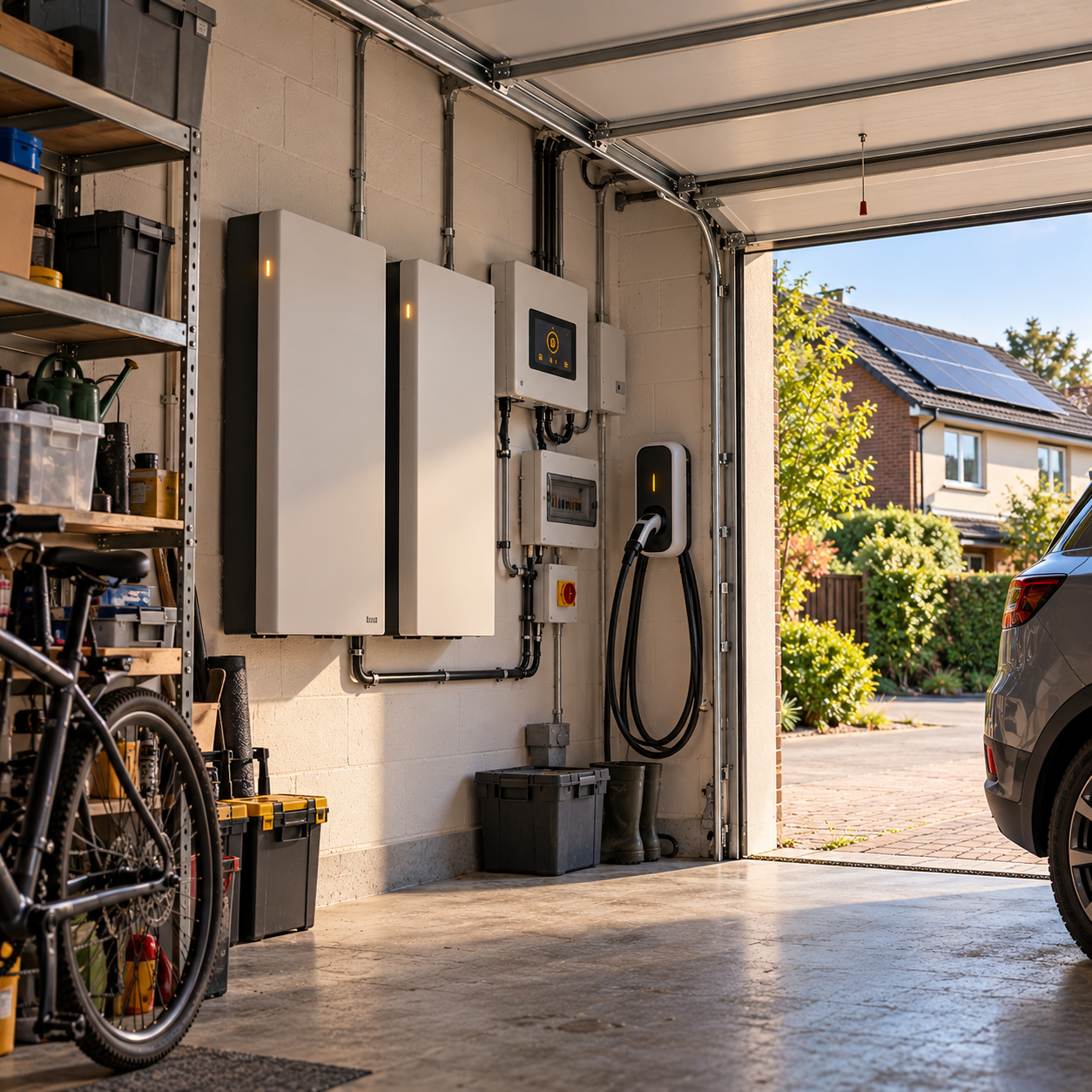
From Using Energy to Managing It
For most households, powering the home has traditionally been fairly straightforward. Electricity comes into the property through the grid, we use what we need, and we pay an energy supplier for the electricity we've consumed.
That doesn't mean we have no control over our energy use. We can switch things off when they're not needed, choose more efficient appliances, turn the heating down or think more carefully about when and how we're using electricity.
But most of this is still about managing how much energy we consume.
What if the home could play a more active role in managing the energy itself?
Solar panels can generate electricity at home. Batteries can store electricity for later. Smart tariffs can make the time you use or store electricity more important. Backup systems can help keep essential parts of a home running during a power cut. And increasingly, technology can help coordinate these different parts of the home.
It's a shift from simply using energy to thinking more carefully about where it comes from, when we use it and what we do with electricity we don't need straight away.
Start by understanding what your home uses
Before generating or storing electricity, it helps to understand what you're already using.
Some appliances only run for a few minutes at a time, while others operate for hours. Heating, cooling, hot water and EV charging can add significant demand in electrically powered homes, while dozens of smaller devices can collectively contribute too.
Smart meters, energy monitors and individual smart plugs can provide useful information about real-world consumption. You can also use tools such as Spacelo's Energy Saver to estimate the electricity use and running costs of appliances around your home.
Understanding that demand gives you a much better starting point for deciding where efficiency improvements — or bigger investments in home-energy technology — might actually make sense.
Generate some of your own electricity
Solar panels are probably the most familiar example of generating electricity at home.
During daylight hours, solar photovoltaic panels convert sunlight into electricity that can be used by the home. If you're generating electricity while appliances are running, some of that demand can be supplied by your own panels rather than drawing all of it from the grid.
The challenge is that electricity isn't always generated at the same time you need it.
Your panels might be producing plenty of electricity during the middle of the day while nobody is home, but your household's biggest demand could arrive later in the evening.
Surplus electricity can often be exported to the grid, depending on where you live and the arrangements available to you. Another option is to store some of it.
Store electricity and use it later
A home battery changes when electricity can be used.
Instead of having to consume solar electricity as it's generated, surplus power can potentially be stored during the day and used later when the panels aren't producing enough.
Solar isn't the only way to use a battery either. Depending on your electricity tariff, a battery may be able to charge from the grid during cheaper periods and supply some of the home's electricity when grid prices are higher. Energy Saving Trust notes that batteries can be used with solar, time-of-use tariffs or a combination of both.
That creates an interesting change in how we think about electricity.
It's no longer only:
Do I need electricity?
It can also become:
When is the best time to get it, where should it come from, and should I use it now or save it for later?
What about a home generator?
Batteries aren't the only option when people want greater energy resilience.
Generators produce electricity rather than storing it. They range from smaller portable generators to permanently installed standby systems designed to provide backup power to a property.
A larger standby generator can potentially keep substantial parts of a home operating for an extended period, provided there is an appropriate fuel supply. That can make generators particularly useful in places where longer or more frequent power outages are a concern.
There are trade-offs, though. Generators require fuel and maintenance and can introduce noise and exhaust emissions. Installation and safe isolation from the electricity grid are also important considerations.
A battery behaves differently. It's generally quiet and can integrate particularly well with solar and smart energy systems, but the amount of backup it can provide is ultimately limited by how much usable energy it stores and how quickly the household consumes it.
Neither is automatically the better solution. The more useful question is what problem you're trying to solve.
What happens when the power goes out?
Saving money isn't the only reason someone might want greater control over their home's energy.
There's also resilience.
If the electricity grid goes down, a suitably configured battery or generator can potentially keep selected parts of the home operating.
That doesn't necessarily mean powering everything as normal. You might prioritise refrigeration, essential lighting, internet equipment, phone charging, heating controls or other equipment that's particularly important to your household.
It's worth asking a simple question:
If the grid went down tonight, what would you actually need to keep running?
There's an important catch with solar and batteries. Simply having solar panels or a home battery doesn't necessarily mean your home will continue operating during a blackout. Backup capability depends on how the system has been designed and installed.
That's something to establish before buying a system if emergency power is one of the reasons you're considering it.
Let the home help decide when to use energy
This is where home energy management starts becoming particularly interesting.
Imagine a home with solar panels, a battery, smart appliances, an EV charger and a time-of-use electricity tariff.
Rather than each operating independently, an energy-management system could help coordinate them.
On a sunny afternoon, surplus solar electricity might charge the battery. An appliance that doesn't need to run immediately could operate while plenty of solar electricity is available. Later, when grid electricity is more expensive, the house could draw from stored energy instead.
At night, a battery or electric vehicle might charge when a suitable tariff offers cheaper electricity.
You don't necessarily want to spend every day checking electricity prices and deciding when the dishwasher should run. The smarter part is technology increasingly being able to handle some of those decisions for you.
And this isn't purely theoretical. Current research into combinations of solar, batteries, heat pumps and time-of-use tariffs shows that coordinating technologies and tariffs can affect household costs substantially — although actual savings vary considerably by property, consumption, system performance and tariff.
Could your car become part of your home's energy system?
Electric cars introduce another interesting possibility.
An EV already contains a large rechargeable battery. Normally electricity flows in one direction: from the home or charging point into the vehicle.
Bidirectional charging can potentially allow electricity to travel the other way too.
Vehicle-to-home technology could allow a compatible EV to provide electricity back to the house, while vehicle-to-grid technology could potentially allow stored electricity to be supplied to the wider grid.
It's still an emerging area rather than something every EV owner can use today. Compatibility between the vehicle, charger, home and local electricity arrangements matters, so it's not something to assume an EV automatically supports.
But it raises an interesting idea: in the future, the car sitting on your driveway could become another part of your home's energy system.
Does managing your own energy automatically save money?
Not necessarily.
Solar panels, batteries, generators and other home-energy equipment can involve significant upfront costs. Whether they make financial sense depends on where you live, your energy prices, available tariffs, household consumption, installation costs, how much electricity you can generate and how you actually use the system.
A battery in particular shouldn't automatically be treated as a guaranteed money saver. Recent Energy Saving Trust research found that batteries can improve flexibility and increase bill savings, but their current upfront cost means the additional savings don't always recover the battery cost within its expected lifetime.
For some households, resilience or greater energy independence may also be part of the value — not just the shortest possible financial payback.
That's why understanding your own home should come before buying the technology.
A more active relationship with energy
Most homes aren't about to disconnect from the electricity grid, and they don't need to.
What's changing is the role the home can play.
Instead of electricity simply arriving from the grid whenever we need it, homes can increasingly generate some of their own power, store electricity for later, choose more advantageous times to use it and potentially maintain some power when the normal supply isn't available.
Not every home needs solar panels, a battery, generator or sophisticated energy-management system. And adding more technology isn't automatically the same thing as becoming more efficient.
The smarter home is the one that understands what it uses first — and then chooses the technology that genuinely helps.