
Do you know what your appliances cost to run?
Most of us know roughly what we pay for electricity, but understanding where that electricity actually goes is much harder. An appliance that uses a lot of power isn't necessarily the one costing you the most — how long and how often you use it matters too.
That's one of the reasons we created the Spacelo Energy Saver: to help you estimate how much electricity the appliances and devices around your home could be using based on the way you actually use them.
High power doesn't always mean high energy use
Appliance power is usually shown in watts (W), while electricity consumption over time is measured in kilowatt-hours (kWh). As a simple example, a 1,000-watt appliance running continuously for one hour would use approximately 1 kWh.
A kettle may draw a lot of power but only run for a few minutes at a time. A lower-powered device such as a Wi-Fi router could stay on 24 hours a day. Other appliances, such as fridges, washing machines and computers, vary their power use while operating.
So wattage matters, but how an appliance is used matters just as much.
So where is your electricity actually going?
The answer will be different from one household to another.
Someone working from home several days a week may have computers and monitors operating for long periods. Another household might use an electric shower every day. Someone who cooks frequently with electric appliances will have a different pattern again.
Even two households owning exactly the same appliances could get different results simply because they use them differently.
Rather than trying to tell everyone which appliance is their biggest energy user, Energy Saver lets you build an estimate around your appliances and how you use them.
Smart Living tool
Find out where your electricity could be going
Choose the appliances you use, tell us what you know about them and see their estimated annual electricity use and running costs.
Try the Energy Saver Tool →How Energy Saver works
Energy Saver starts by asking where you live and what you pay for electricity. You can enter the unit rate from your electricity bill or, where we have reliable data available, use a typical rate for your country.
You may notice that not every country is currently available. That's deliberate. Electricity prices vary considerably between countries, and we only want to provide a typical rate where we can base it on a source we consider reliable. We'd rather leave a country out for now than give you a cost estimate based on information we don't have enough confidence in.
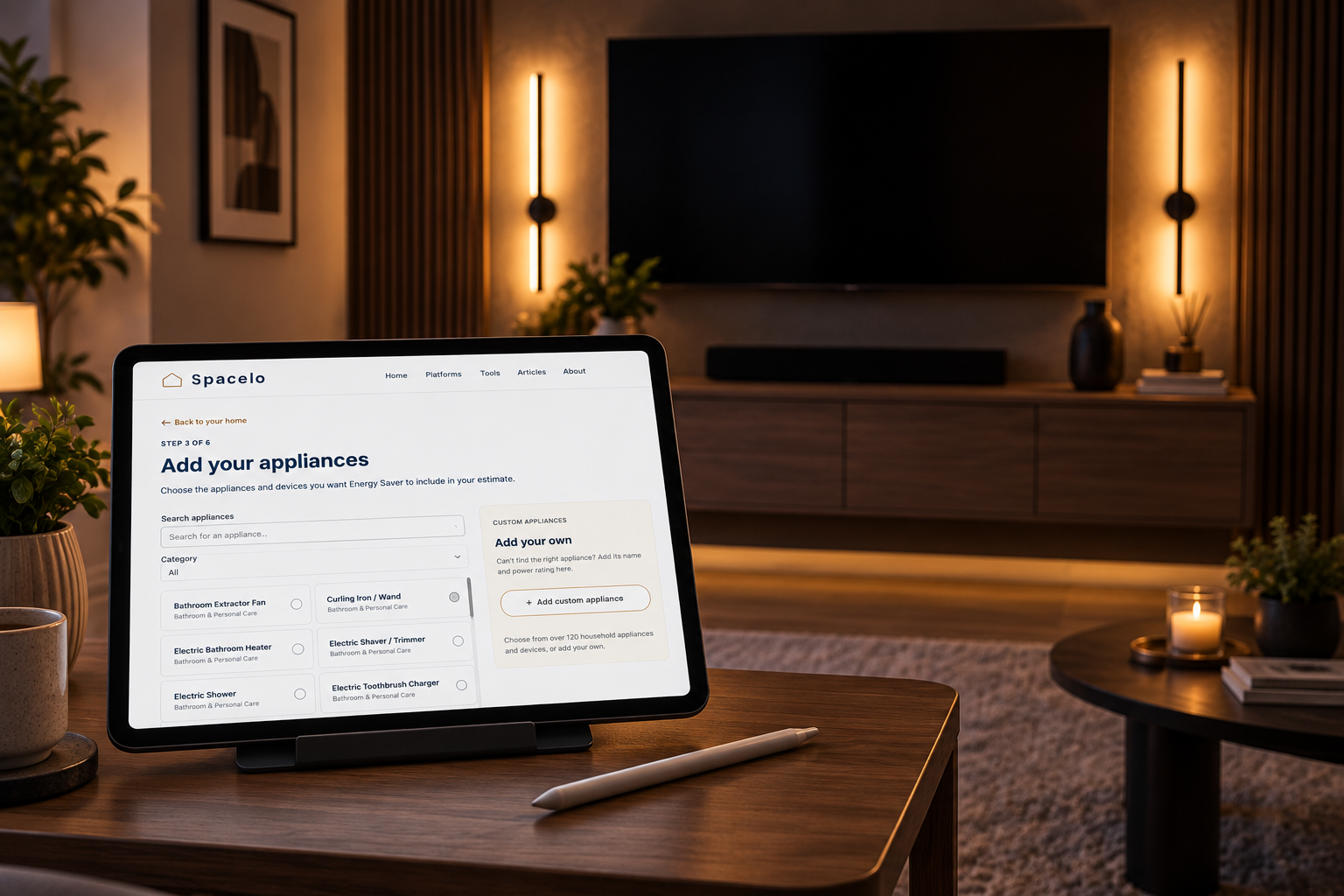
Next, tell us a little about your home before choosing the appliances and devices you'd like to include. Energy Saver has a catalogue of more than 120 household appliances and devices that you can search or browse by category. If you can't find what you're looking for, select Add custom appliance to add your own.
For each appliance, we'll ask a few questions about how you use it, such as how many hours you typically use it each day, how many days a week you use it and whether it normally remains powered or on standby when it isn't actively being used.
If you know the appliance's wattage, adding it can improve the estimate. You can often find this on the appliance label, power supply or adapter, in the user manual, or in the manufacturer's specifications for your exact model. If you're checking online, try to use information for the exact model rather than a general figure for that type of appliance.
Don't know the wattage? That's okay. You can select Not sure, and where we have suitable typical values available, Energy Saver can still produce an estimate based on the information you provide.
You don't need perfect information to use the tool. However, there may be cases where we don't have enough information to produce an estimate we're comfortable showing. Rather than filling the gap with a figure that could be misleading, Energy Saver will tell you that the appliance needs more information and give you the opportunity to add it.
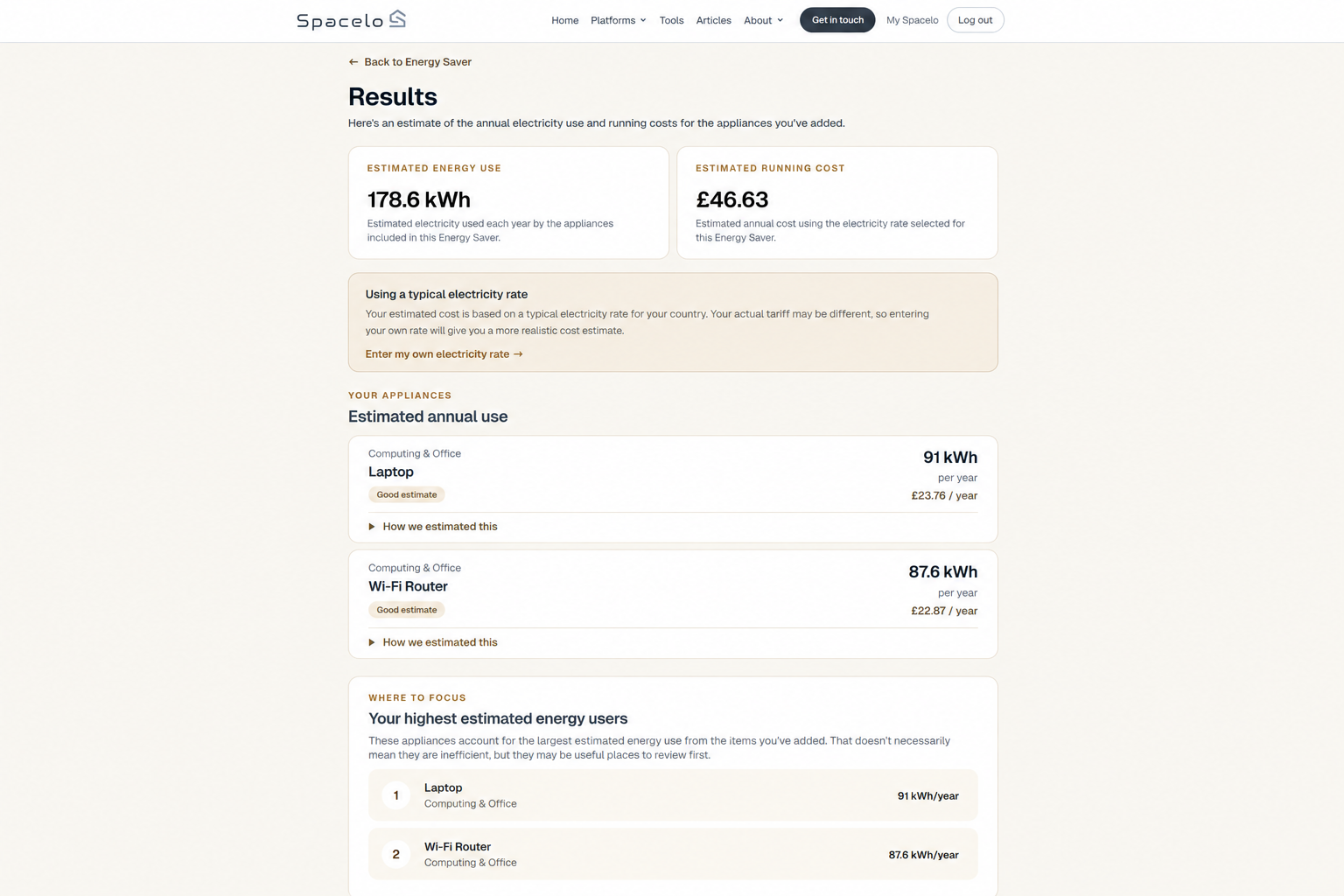
Once you've finished, you'll have a chance to review what you've entered and make any changes before calculating your results. Energy Saver then estimates the annual electricity use and running cost of the appliances it has enough information to calculate, helping you see which of the items you've added account for the most estimated energy use.
Your biggest energy user isn't necessarily your worst appliance
Energy Saver highlights which of the appliances you've added have the highest estimated energy use. That doesn't necessarily mean they're inefficient or that you should use them less — they may simply be used more often or for longer.
Instead, think of these results as where to look first. Is something running longer than necessary? Is there an energy-saving setting you could use? Does it remain powered when it doesn't need to?
Sometimes there'll be something worth changing. Other times, you'll simply confirm that you use a particular appliance a lot because you need it — and that's useful to know too.
Small devices can add up
One interesting result may be discovering that the appliances you barely think about still contribute to your electricity use.
Routers, entertainment equipment, computers, chargers and other devices can spend long periods switched on or waiting in standby. Individually, some may use relatively little electricity, but duration matters.
That doesn't mean you should start switching everything off without considering what the device does. Some equipment is designed or expected to remain powered, and switching off certain connected devices can affect updates, recordings, security systems or other functions.
Instead, use your results as a reason to ask a simple question:
Does this need to be using electricity for as long as it currently does?
Could smart technology help?
Sometimes it can.
A suitable smart plug can schedule when a device receives power, while models with energy monitoring can help you understand how much electricity a compatible plug-in appliance actually uses. Smart heating controls can make it easier to manage when your home is heated, and automation can help prevent certain devices being left running unnecessarily.
But buying another smart device isn't automatically the answer.
If changing a setting or simply switching something off when it isn't needed solves the problem, that's often the simpler solution. Smart Living isn't about adding technology everywhere — it's about using it where it genuinely makes something easier or better.
Remember: Energy Saver provides estimates
Energy Saver isn't connected to your electricity meter, so the figures it provides shouldn't be treated as measurements of your actual household electricity consumption.
The calculations are based on the appliances you've selected, the usage information you've provided and typical values where suitable ones are available. Actual consumption can vary depending on the exact model, age, settings, operating conditions and how an appliance manages its power.
Your actual electricity tariff may also differ from a typical country rate. If you know the unit rate you currently pay, entering it into Energy Saver will give you a more personalised running-cost estimate.
Energy Saver estimates electricity use from the appliances and usage information you add. It isn't intended to reproduce your full household electricity bill, and standing charges aren't included in appliance running-cost estimates.
The aim isn't to predict your next electricity bill down to the penny. It's to give you a useful way to compare the appliances you use and understand where your electricity could be going.
Save your estimate and come back later
If you're signed in to Spacelo, you can save your results to My Energy Saver. That means you don't have to treat your first calculation as the end of the process.
You could return after changing how you use certain appliances, update your electricity rate or create another estimate as things change around your home. Over time, that makes Energy Saver useful not only for getting a snapshot, but for comparing different scenarios.
You don't necessarily need to make dramatic changes. Understanding your energy use is the first step towards deciding whether anything is actually worth changing.
Start with your own home
It's easy to find lists online telling you which household appliances use the most electricity, but those lists can't know how you use yours.
Energy Saver is designed to start with your home instead. Add the appliances and devices that matter to you, provide as much information as you know, and let the results show you where it may be worth looking more closely.
You might confirm exactly what you expected.
You might find that something you assumed was expensive barely registers.
Or you might discover that a relatively unremarkable device has quietly been running for thousands of hours a year.
Smart Living tool
Ready to see where your electricity could be going?
Use the tool to get better understand how much electricity your appliances uses.
Try the Energy Saver Tool →